For years, the definition of a “green building” in India was largely passive. It meant thick insulation, double-glazed windows, a few rooftop solar panels, and a shiny certification plaque from the Indian Green Building Council (IGBC) or GRIHA hanging proudly in the lobby.
But there’s a quiet, candid truth the construction industry has had to confront: a building designed to be green can still be operated like an energy vampire. If a certified energy-efficient HVAC system runs at full blast in an empty conference room or a rainwater harvesting system overflows unnoticed, the sustainability is purely symbolic.
As India aggressively scales its green infrastructure, targeting a massive expansion of certified green footprints, the focus has shifted from intentional sustainability to operational performance. The bridge between the two? The Internet of Things (IoT). Driven by the Smart Cities Mission and strict compliance codes, the Indian smart building market has exploded from USD 15.5 Billion in 2025 toward an estimated USD 113.1 Billion by 2034.
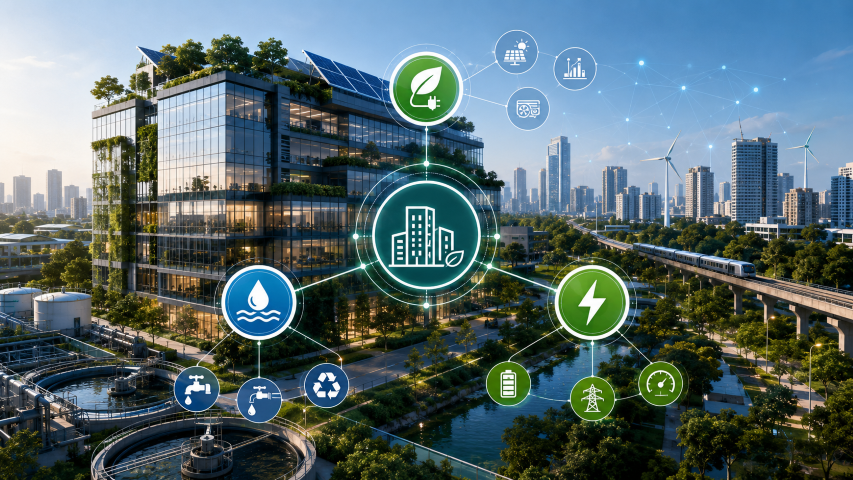
IoT has become the digital nervous system of modern Indian infrastructure, fundamentally reshaping how we manage energy, power, and water.
- The Energy Perspective: Eradicating Operational Waste
Cooling and lighting dominate a building’s operational energy footprint, especially given India’s diverse and often extreme tropical climate zones. Traditional building management systems operate on rigid, pre-programmed schedules. IoT breaks this rigidity by introducing real-time, demand-driven automation.
- Dynamic HVAC Optimisation: IoT environmental sensors track real-time occupancy, ambient temperature, and humidity. Instead of cooling an entire floor uniformly, smart systems route airflow exclusively to occupied zones. This real-time optimisation slashes commercial energy consumption by 20% to 30%.
- Intelligent Lighting Grid: Ambient light sensors continuously communicate with LED drivers, dimming artificial lights when natural sunlight streams through high-performance glass facades.
- The Path to Net-Zero: The Bureau of Energy Efficiency (BEE) projects that a quarter of all new commercial structures in India will aim for Net-Zero Energy Building (NZEB) status. Achieving this requires the hyper-granular data that only IoT can provide, ensuring that every single kilowatt-hour consumed is accounted for and justified.
- The Power Perspective: Grid Resilience and Predictive Assets
While “energy” focuses on the total quantum of electricity used, “power” is about delivery, stability, and asset health. Modern green infrastructure doesn’t just draw power from the state grid; it manages localised microgrids consisting of rooftop solar arrays, captive wind turbines, and battery energy storage systems (BESS).
- Orchestrating the Microgrid: IoT acts as an automated traffic cop for power. It monitors peak grid tariffs in real time, automatically switching the building’s power source to stored solar battery power when grid prices spike and recharging those batteries when grid power is cheap and clean.
- Predictive Maintenance vs. Catastrophic Failure: High-voltage assets like distribution transformers, capacitor banks, and large industrial chillers are prone to breakdown under heavy loads. IoT thermal and vibration sensors track asset health continuously. By analysing these data streams, facility managers can predict mechanical or electrical faults before they cause a blackout. This proactive approach has driven a 40% increase in predictive maintenance adoption across Indian commercial assets, significantly extending equipment lifespans.
- The Water Perspective: Mitigating the Urban Scarcity Crisis
The Stark Reality: According to NITI Aayog, nearly 600 million Indians face high-to-extreme water scarcity. Compounding this crisis, Indian urban water utilities lose nearly 40% of their treated supply to Non-Revenue Water (NRW) which includes hidden underground leakages, commercial theft, and structural losses.
In this landscape, green buildings cannot afford to treat water as an infinite resource. IoT has turned water management from a guessing game into a precise science.
- Micro-Leak Detection: Traditional water meters only show aggregate consumption at the end of the month. IoT-enabled ultrasonic flow meters monitor pipeline pressure and flow variations in real time. If a pressure drop occurs between two nodes at 2:00 AM, the system immediately flags a leak, pinpoints its location, and can even trigger automated shut-off valves to prevent catastrophic water loss.
- The Circular Water Economy: Advanced green buildings rely on decentralised Sewage Treatment Plants (STPs) and greywater recycling to achieve net-zero water goals. IoT sensors continuously track critical water quality metrics like pH, turbidity, and chemical levels. This automated telemetry ensures treated wastewater safely meets structural reuse standards for flushing and landscaping, eliminating human error from the recycling loop.
The Triple-Threat Matrix: IoT Operational Impact
| Resource Vertical | Core IoT Application | Primary Metric / Targeted Impact | Aligned National Framework |
| Energy | Smart HVAC, occupancy tracking, automated LED dimming | 20–30% reduction in commercial electricity use | BEE’s Energy Conservation Building Code (ECBC) |
| Power | Distributed solar routing, battery storage telemetry, transformer monitoring | 40% reduction in asset downtime via predictive maintenance | National Solar Mission & Smart Cities Mission |
| Water | Pressure analytics, ultrasonic metering, automated STP quality tracking | Slashing Non-Revenue Water (NRW) losses below 25% | AMRUT 2.0 & Jal Jeevan Mission |
Conclusion: The Era of Measurable Sustainability
Building green can no longer be a passive checklist or a clever corporate public relations exercise. As India marches toward its climate goals and its structural blueprint for Viksit Bharat, true sustainability must be mathematically verified and continuously maintained.
With tens of millions of IoT devices being woven into the concrete fabric of India’s developing cities, the nation is moving past the era of structures that simply look sustainable on architectural blueprints. We are entering the era of infrastructure that thinks, adapts, and saves resources in real time.